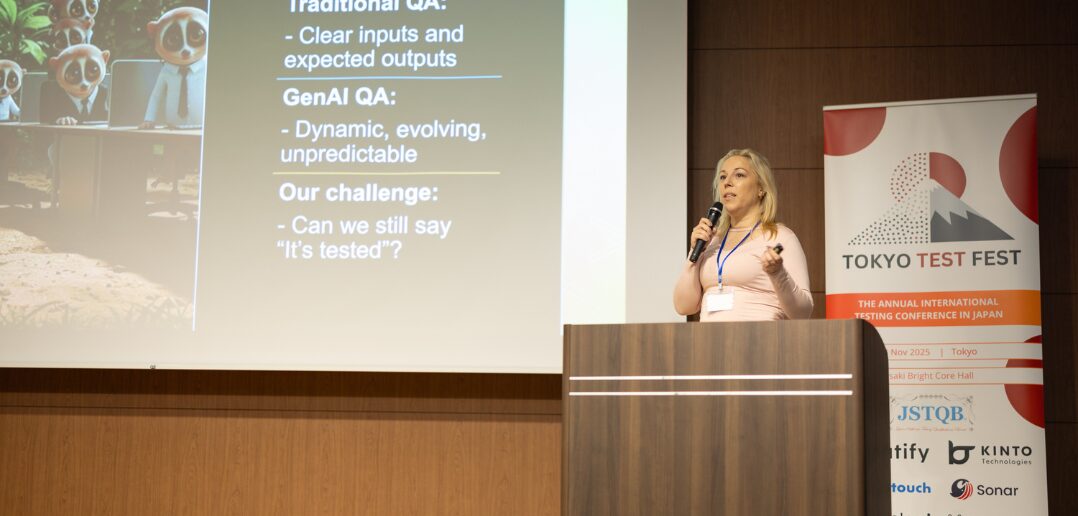
Dušanka Lečić, Test Lead at Levi9, recently completed a remarkable international speaking tour, sharing her expertise on AI testing at two of the world’s most prestigious testing conferences.
Beginning at TestWarez in Poland on November 6th and culminating at Tokyo Test Fest 2025 on November 13th, her presentation “From Bugs to Brilliance: How to Test Your Chatbot Effectively” addressed one of the most pressing challenges facing quality assurance professionals today: how to effectively test AI applications in an era where traditional testing approaches no longer suffice.
From Europe to Asia: One Mission in QA in AI era
The journey began at TestWarez in Poland, one of Europe’s leading software testing conferences. TestWarez has long been recognized as a hub for testing professionals seeking cutting-edge knowledge and practical solutions, making it an excellent venue to launch this important conversation about the future of QA in the AI era.
Just one week later, Dušanka brought these insights to Tokyo Test Fest 2025, known for bringing together testing professionals from across Asia and beyond. The conference’s reputation for fostering deep technical discussions and cross-cultural knowledge exchange created an ideal environment for continuing the exploration of AI testing complexities with a fresh audience on a different continent.
Breaking New Ground in AI Testing
The influence of AI tools on building and testing applications has been undeniable, yet it has also revealed a critical gap: QAs need new methodologies to test AI applications effectively. Unlike traditional testing with its predictable positive and negative test cases, testing Generative AI applications is inherently unpredictable and demands a fundamentally different approach.
Dušanka’s presentation tackled this challenge head-on, asking the crucial question: Can we, as professionals, truly guarantee that AI applications are tested and of good quality?
Her talk provided both clarity and practical guidance, using a Retrieval-Augmented Generation (RAG) application as a concrete example. She walked audiences through the implementation process, demonstrating how to leverage vector databases, compare retrieved and generated content, and employ agents and tools that facilitate thorough testing. By breaking down application documents into manageable chunks and utilizing vectors and similarity search, she showed how QAs can ensure the accuracy and relevance of generated content.
Importantly, Dušanka highlighted the key differences between testing GenAI and traditional applications. While traditional testing relies on predefined scenarios, GenAI testing requires managing unpredictable outputs while ensuring logical consistency, factual accuracy, and contextual relevance, demanding innovative strategies and specialized tools to meet these unique challenges.
TestWarez: Setting the Stage
At TestWarez on November 6th, Dušanka launched her international tour among Europe’s vibrant testing community. The conference’s focus on practical, hands-on knowledge aligned perfectly with her presentation’s goal of providing actionable strategies for testing AI applications. The engagement and questions from the Polish audience set a strong foundation for what would become a week of intensive knowledge exchange across continents.
The Tokyo Test Fest Experience
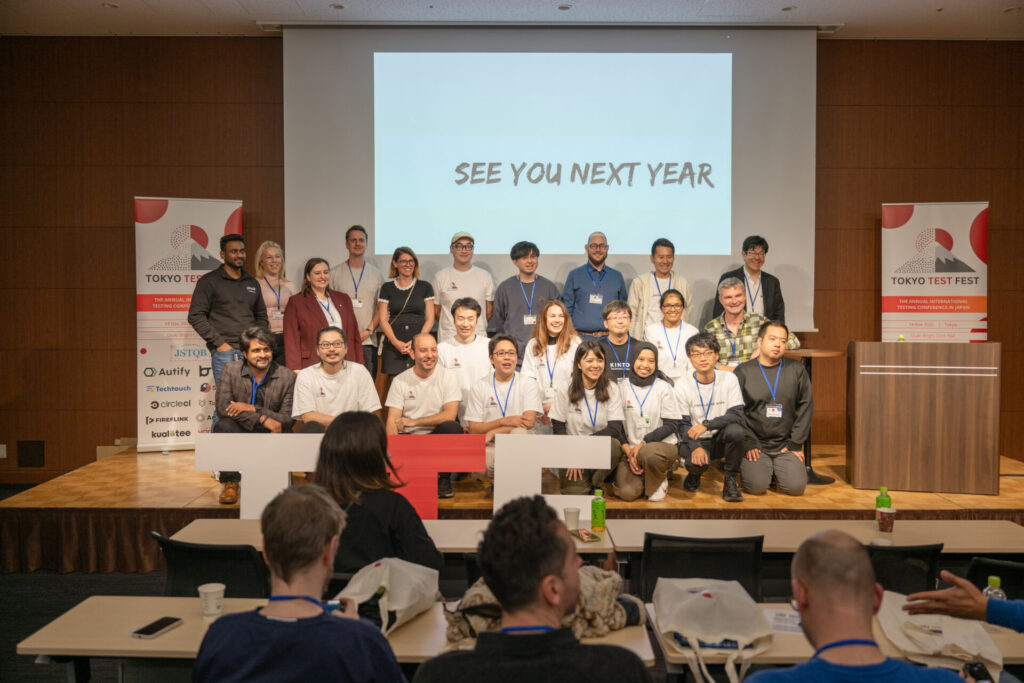
When Dušanka stepped into Tokyo Test Fest 2025 on November 13th, she immediately sensed the energy of a community deeply passionate about software quality and innovation. What began as a presentation evolved into something far more meaningful: a genuine dialogue filled with curiosity, sharp questions, and authentic enthusiasm from the audience.
The conference’s international atmosphere, with testing professionals gathering from across Asia-Pacific and beyond, created unique opportunities for cross-cultural exchange. Different perspectives on testing challenges and solutions enriched the conversations, demonstrating how quality engineering transcends geographical boundaries.
The week between Poland and Tokyo had allowed Dušanka to refine her message, and the fresh perspectives from the Asian testing community added new dimensions to the discussion.
The feedback she received at both conferences served as a powerful reminder of why events like TestWarez and Tokyo Test Fest matter. They transcend more knowledge exchange, building bridges between professionals from around the globe and creating connections that span continents and cultures. Dušanka left both Poland and Tokyo not just satisfied with successful presentations, but truly inspired, grateful, and motivated to continue pushing the boundaries of testing in the age of AI.
Building a Global Testing Community
As AI continues to transform the software landscape, voices like Dušanka’s – practical, insightful, and rooted in real-world experience, are essential in guiding the QA community through this evolution. Her journey from TestWarez to Tokyo Test Fest demonstrates not only technical excellence but also the power of sharing knowledge across borders and building a global community committed to quality and innovation.
The conversations sparked at these two prestigious conferences, from the halls of TestWarez in Poland to the vibrant atmosphere of Tokyo Test Fest, will undoubtedly continue to resonate throughout the testing community, helping QA professionals worldwide navigate the exciting and challenging landscape of AI application testing. Through events like these, and speakers willing to share their expertise across continents, the future of quality engineering grows brighter and more collaborative with each passing day.
Levi9 Impact in Action
Duška’s participation across two continents was made possible by strong company support and trust in her expertise
“A special thanks to my company for supporting me on this journey,” Dušanka reflected. “They’ve enabled me to grow, share, and represent our vision on an international stage. Together, we’re shaping the future of quality engineering.
This commitment is clearly reflected in the impact she created at both European and Asian conferences.
In this article: